
THB #854: The Odyssey

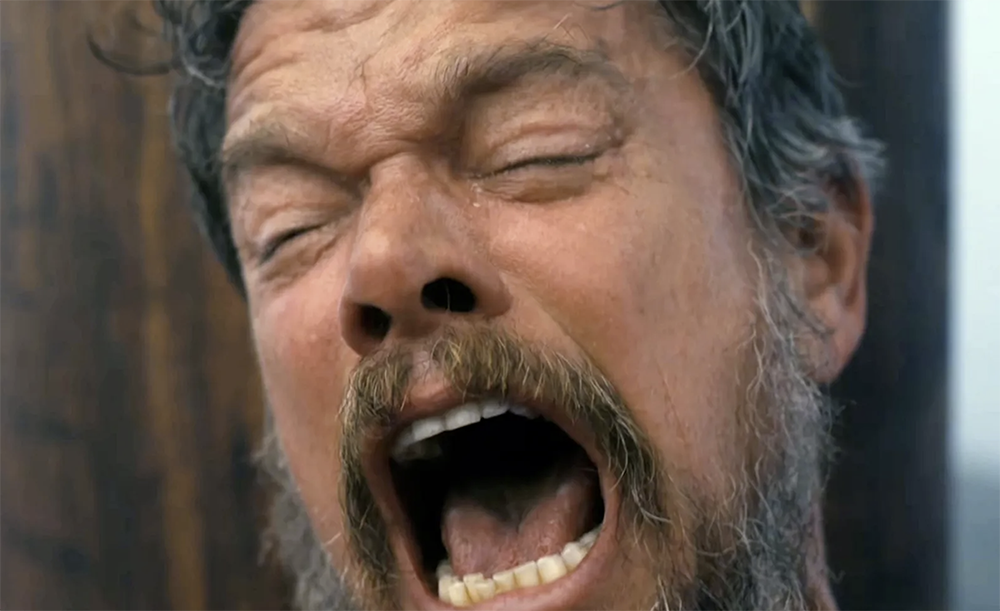
The Odyssey is very much a blood sibling of Oppenheimer. Both films are the story of a man of singular skill and passion who suffers an enormous weight as a direct result of their own actions that were taken in earnest.
Christopher Nolan’s journey as a filmmaker has had 2 paths. First, as a craftsman. We have seen the signs of this from his first successful release - which was fraught in it arrival - in Memento. Nolan has grown every time out as a cinematic craftsman, as highly skilled and respected as exists at this time. His work as a filmmaker of rich emotional statements has been less direct. Memento was clever as hell… but to what meaning? Insomnia was born of someone else’s story. The Dark Knight trilogy was really someone else’s story again. The Prestige is battle of two men, but leans again to the clever and intellectual more than any deeper themes. Inception is a mind-blowing heist movie. With Interstellar, Nolan, with a pre-teen of his own, seem to have had the world and parenting on his mind as he thought about the future, the past, and the deepest emotional connections. In Dunkirk, with all the filmmaking skill that anyone could muster, Nolan ultimately tells a story about normal people saving the day when faced with the gravest of historic consequences. And if you know what Tenet was really about, please inform me. (I give myself an Incomplete on that one.)
But Oppenheimer, for me a masterpiece, brought us to an artist approaching and then in his 50s, considering the weight of the world. A filmmaker who had succeeded by every normal standard, making a movie that would fill out the final pages of that passport as a legendary filmmaker. (Note: I don’t think that Oscar, etc, - accolades - was what he had in mind.)
Nolan made an action movie out of the most boring imaginable movie subject… science. He brought to life all of the passion and intentionality out of great scientists and their work, led by as dry a central figure as imaginable in Oppenheimer. He kept the tension up. He made numbers and ideas that are really beyond 99% of the audience’s ability to really comprehend (including me) and turned them into feelings, a part of the movie experience that has never been his strong suit. And then he blew up The Bomb in one of the greatest movie sequences ever.
But it was just the test. It was the end of the 2nd act of the film. And we would not see any repeat. Not at Hiroshima or at Nagasaki… the only times in history that one nation has dropped a nuclear weapon of any major scale on another nation. What becomes the 3rd act is weaved through the entire film, but it is pretty much the entire 3rd act, an hour of movie time. What hath Oppenheimer wrought? What are the real penalties? What are the conceptual penalties? Even though many took part in the choices and the actions that led to the ultimate consequences, what is it to be The Man who so dramatically and so horribly changed the world? To carry that through the rest of your life?
Which brings us to The Odyssey.
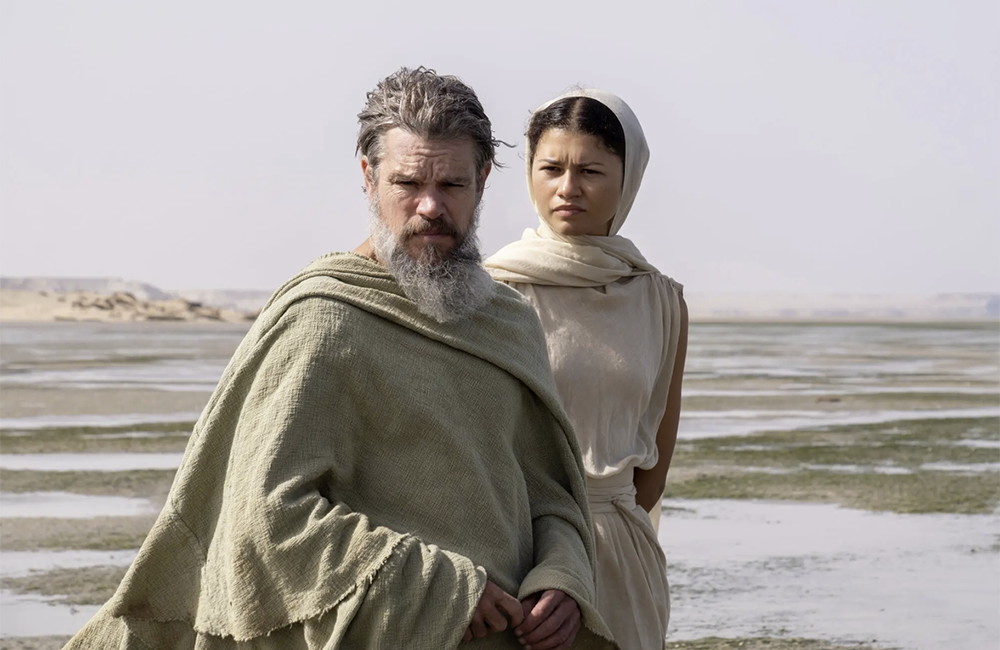
This is a movie of massive scale and range. This movie embodies all of Christopher Nolan’s grown and acquired skills as a craftsman on the very highest of levels, perhaps matched only by Jim Cameron in the current generation of over-50 filmmakers. (Please note: I am not dismissing any or all of the current masters of cinema. The deification of, for instance, all 3 Amigos, is real. It just hasn’t quite offered, for all the well-earned Oscars, what Cameron and Nolan have. It’s different. Usually by choice, which is a good thing for art. Different conversation, well worth having at another time and place.) Spielberg and Scorsese and Coppola stand for the generation just before them, who have been able to play with this generation‘s technology, but really mastered the pre-digital skills and changed cinema in their way. I would include Lucas, as I lay that it out that way, as he, more than anyone, really, straddled the pre-CG and the CG universe in the Star Wars movies alone. But he never really turned that into leadership and mastery outside of that bubble as a director while the others did.
But I digress…
The core of The Odyssey, which I admit did not fully settle in for me until seeing it a second time, is very much the core of Oppenheimer… what the hell has Odysseus done to the world, as played out in the mind of Odysseus himself?
The journey is less of an intellectual experience than the 3rd act of Oppenheimer. The intellectual journey of Odysseus is not as much a journey of the mind. It is a literal, albeit magical, journey of about a decade. And Odysseus is not the intellect that Oppenheimer was, though he is often refereed to as the smartest of Agamemnon’s generals. He is a top notch problem solver. He is the problem solver credited with The Trojan Horse, which the movie sees, not for nothing, as the nuclear bomb of this period of time in history, however literal or mythological.
There are plenty of, let’s say, magical creatures in Nolan’s take on The Odyssey. Many moments created by those creatures offer truly fantastic movie moments. So… very Nolan. But more importantly, they are all reflections of Odysseus’ shame. Each of the 5 magical beings that manifest in big set pieces and a few others that manifest in other ways, speak to Odysseus’ fear that he has been a central party to destroying the time of Gods, which he still believes in and sees as the connective fabric of human society.
Ironically, with all the idiotic noise about less traditional casting of certain roles in the film, this core belief by Odysseus, amongst many in the film, could easily be seen as right-wing and/or religious thinking, making it a film for those mostly attacking it in media. (Worth Noting: The casting guesses were often factually wrong and the ones that were not were not only hateful and idiotic on their face, but much more so after seeing the film in its entirety. A spoiler discussion of the very small role of Helen of Troy in this movie could easily take the tack of the horribly racist and paranoid position of many on the Trump Right. But I feel a need for a shower just thinking about it, much less voicing it, and the whole notion will have to wait for another day.)
But again, I digress…
The Odyssey is a very difficult movie to complain about. (Yes, a few are finding it very easy. To each their own.) Nolan’s work is impeccable. The manifestation of the ideas he is conveying is masterful.
However… the one thing that left me uncomfortable from the first time seeing it and stuck with me in the second and the third, was the emphasis on Odysseus’ family more than his journey. And certainly, the amount of Odysseus on-screen time vs his wife and son and The Suitors leans heavily to Odysseus. But the first hour of the movie leans towards what it happening in Ithaca (Odysseus’s home that he is trying to get back to for 2,5 hours of the film).
As I watched the film a few times, I thought about how much the Ithaca sequences (including a side journey by the son, Telemachus) could be cut or edited down without damaging the overall story. There is no easy answer. And the events at Ithaca are not uninteresting or poorly presented in some way.
The problem is, for me, that the movie is about Odysseus and his journey home. It’s soul is about Odysseus and his wrestling with his actions and where they led in Troy, and to some degree, after. Complexity is great. But the movie is not about Odysseus’s queen, Penelope, and how painful and difficult it was for her protect Ithaca and Odysseus’ empty throne for 20 years. She stoond her ground, limited by being a woman in that culture, despite being left at 20-ish (in this version), pregnant for the first and last time, aging into a mature and possibly post-menopausal (in that era) woman. I would be really interested in seeing that movie. But this is not that… even if there are a few quite specific moments of dialogue on these issues in the film. Telling us is not showing us. For me, the tease of bigger ideas around Penelope was irritating, really, as I wanted to the movie to go there and not just acknowledge the truth for a minute here or there in dialogue. (This extends, badly, to her lead servant, whose behaviors feel like they once had 4x the screentime and got cut to keep it under 3 hours. We have seen better takes on that character 300 times.)
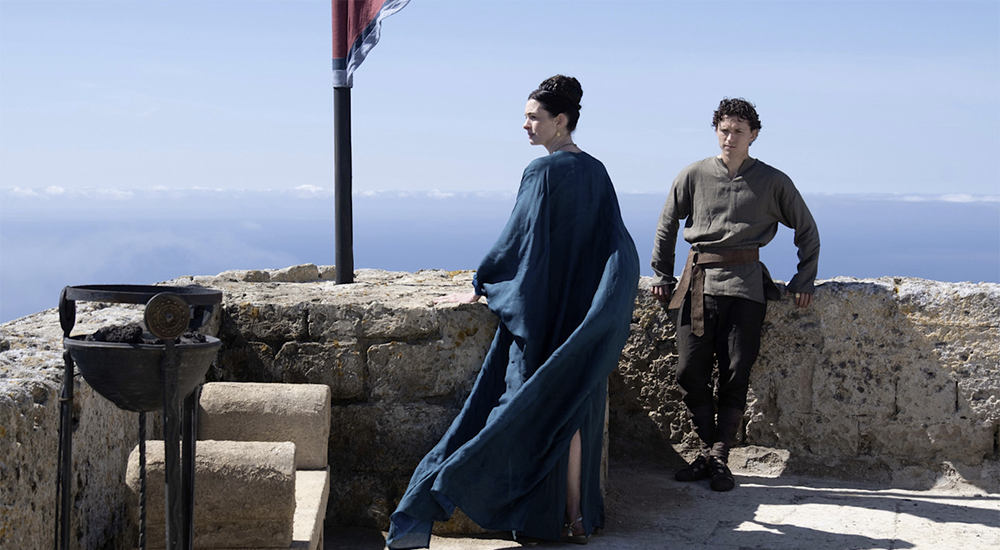
Nor is this a coming-of-age movie for Telemachus. I mean, it kinda is… but this isn’t really what the movie is about. His maturity and growth do matter to the story overall, but it doesn’t touch on the biggest overarching theme of the film. Telemachus doesn’t have the perspective to really even consider the issues that are what Odysseus’ journey is about.
Robert Pattinson gets to snarl and plot as the lead suitor, Antinous. But he too… not a character who speaks to the big theme of the film. He fills a role and he fills it well, but he is a fraud in every way… which is no spoiler, as the audience knows from the start. His character does figure into the third act in a more complicated way than the audience might expect… but this is still a character of function, not insight.
Only John Leguizamo’s Eumaeus offers the perspective that mirrors Odysseus from afar. Leguizamo is great and legitimately will compete for a Best Supporting Actor nomination. But I still wonder why Nolan is Dafoe-shy… as the role seemed like an obvious Dafoe role. As great as Leguizamo is, Dafoe is Dafoe. Does Dafoe belong to Eggers in Nolan’s view or something? Did Willem ask him what Tenet meant? (shrug) But a really interesting and unexpected choice that works beautifully and Leguizamo deserves a lot more media buzz.
So the thing is… I don’t really give a (full) shit about what is happening back in Ithaca. Yes, it is where he is headed. Yes, the audience goes nuts in that last 30 minutes. Why? Because it is gives us the thing we have been waiting for over the previous 2.5 hours. It is, in many ways, the bomb test sequence in Oppenheimer. Sweet relief from all the tension. And this time, screenwriter Nolan put it at the end instead of at the end of the 2nd act.
I do not think for a second that Christopher Nolan considered the backlash against the 3rd act of Oppenheimer when writing this. For one thing, the movie is a journey and it ends where it ends. Unavoidably. But more so, Nolan will put what he thinks belongs wherever he thinks it belongs. He isn’t selling his story, he is telling it, and he has the freedom to do as he truly sees fit.
But again… Ithaca just isn’t that complicated. And by emphasizing it with so much screentime in the first act, I feel it distracts the audience from buying into the core theme of the film which is not one of many, but once you figure it out, is quite specific and deserves to be more clearly highlighted. And this is one of the Kubrickian truths of Chris Nolan… he is sometimes so committed to not spoon-feeding the audience, he takes the spoon and shivs the audience in the groin, distracting them from the real themes as they bleed uncomfortably over something else, forcing them into doing the hard work of getting back to the sweet meat that was his theme from the start.
(Side Note: After seeing The Odyssey, look up The Return on Paramount+ or you can rent a stream. It is an excellent 2-hour indie/1970s-style take on the last 30 minutes of story in The Odyssey - starring Ralph Fiennes and Juliette Binoche, directed by Uberto Pasolini, and written by John Collee, Edward Bond, and Uberto Pasolini - and is really worth the time. But do see The Odyssey first.) Not an ad.
All that said, the ending 30 minutes is where The Odyssey splits from Oppenheimer. Odysseus’ journey is, for all the adventures on it, is about the time and challenges Odysseus needs to decide that he, himself, should go home. He always wants his crew to get back to their lives. He seeks peace for all. This always matters to him. But even in his perceived victory, his shame is that he understands his contribution to the death and destruction of others, which causes him to not really want to go home.
Oppenheimer cannot go home again. His world-changing-success/personal failure will chase him to his grave. And maybe the same is true for Odysseus. But the long journey home allows him some variation on his guilt and his idea of his responsibility after his self-perceived failure.
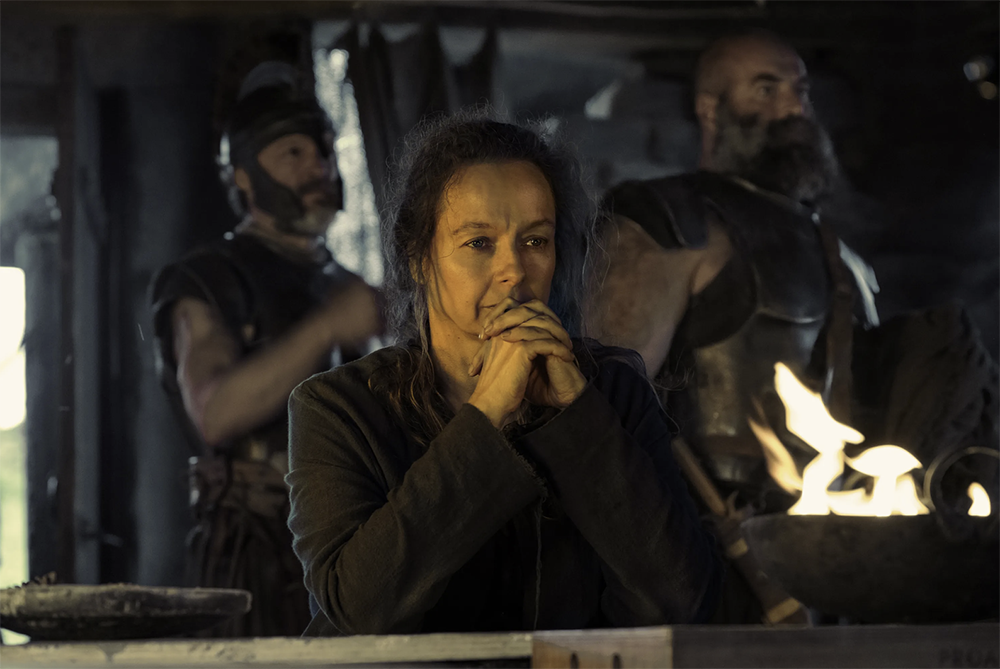
In terms of the “magical” characters along the journey, everyone’s standout seems to be Samantha Morton as Cerce. With good reason. It is a classic Samantha Morton performance. All her soul on display as few have ever done it on a screen. Cerce speaks to, without speaking directly to it, Odysseus’ fear of who his men - and ultimately, himself - really are.
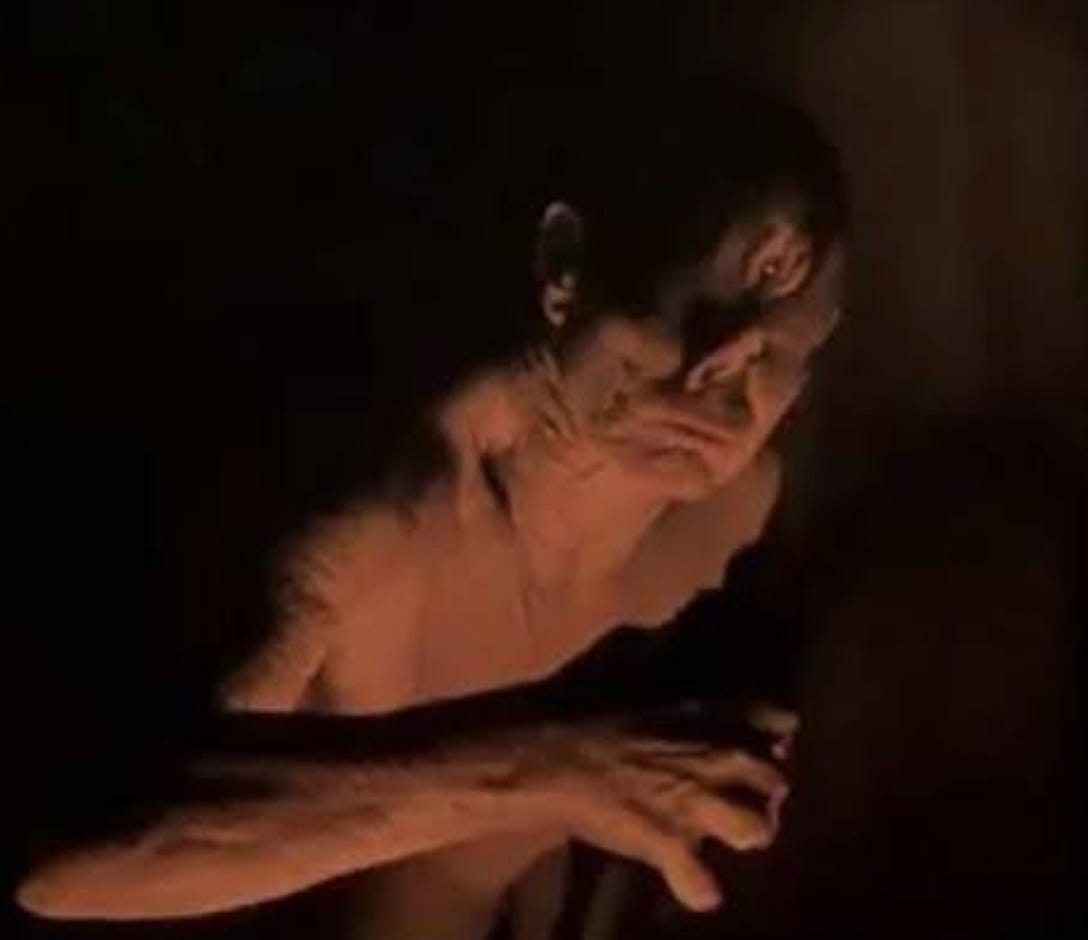
Cyclops (known as just that in the film, bu named Polyphemus in the poem) is played by the great actor and clown Bill Irwin, who is now 76 years of age, but is still capable of delivering in the most beautiful of ways. In this case, this includes his aging naked (no genitals shown) body and the magical ways he moves it. In this film, Cyclops is extremely dangerous, but not really trying to be so. He is disabled (his one eye presented as a birth defect, along with his undeveloped eye sockets and sideways nose) and silent. At every step of engaging, unintentionally, with Cyclops, Odysseus shows his strategic mastery and his failures as well.
Zendaya appears to Odysseus as Athena… but to no one else. She expresses thoughts that are likely coming from his mind, but which he cannot speak for himself.
And Calypso (played by Charlize Theron) gets the longest time with Odysseus. Most people seem to think that in the poem, the relationship is sexual, as she falls in love with him and wants sex, even if he does not. They even have twin boys in the poem. Not in the movie. They barely touch in the movie. In the poem, he always is expressing that he wants to go home. In the movie, he wanders in and out of memory, eventually coming to clarity and leaving Calypso’s island without her really trying to stop him. But the conversations between them have a lot to do with his ambivalence about going home, in general. So in this film, rather than her holding him captive, she is another “magical” character who reflects his inner feelings.
There are non-specifically performed “magic” creatures as well. Giants. Monsters. Whirlpools.
And there are The Dead, who chat with Odysseus. One of them, who I thought was an uncredited Stellan Skarsgård was James Remar, who is part of the Nolan movie family and wears a sweater vest in 48 Hrs like no one before or since. There is one character, who is considered controversial by dumb people (with a “b”), who turns up amongst the dead.
Speaking of which, there are a few other key performances of non-magical characters. The one that gets the most screentime is Jon Bernthal as Menelaus, the brother of Benny Safdie’s Agamemnon. He is home long before Odysseus, arriving with with his Trojan wife, Helen (yes, that Helen), the twin sister of Agamemnon’s wife, Clytemnestra. Odysseus’ son, Telemachus, visits Menelaus for advice and gets an earful from Helen. Lupita Nyong’o plays both sisters and with little screentime for either, delivers poignantly in her brief exchanges with Telemachus. The only showing of Clytemnestra is in the showing of a story that is being told about her.
In the trailers… and even in the movie at times… it would be easy to mistake Benny Safdie’s Agamemnon for the famous fighter Achilles. But Achilles is not in this movie. In the poems, as you might know, Achilles was there for the fight, but he was killed outside the walls of Troy and never entered the city while he lived. In any case, Agamemnon is the large, dark, uniquely armored character who has the gold braiding on the back of his helmet. The character, in this film, is almost silent.
There are other familiar faces in the film, primarily Corey Hawkins and Himesh Patel, both of whom are effective… but they serve the story and don’t define much in terms of the theme.
Long review… lots to cover… epic? (That’s your call)
For me, the film could have been better had Nolan and his brilliant editor, Jennifer Lame, pulled about half of the Ithaca footage. It’s not that any of it is bad or weak. It’s just not really what the movie is about. The movie is about the odyssey of Odysseus trying to get home, weighted down by what he made happen at Troy by coming up with the idea of the horse… and more. And the movie is just too loaded with distractions from that core theme, even if they are well done.
It’s still pretty amazing. It is still a feast. The images from Nolan and his cinematographer, Hoyte van Hoytema are going to be hard to beat in the Oscat category next March. Damon is sure to get his 3rd nomination for Best Actor and Samantha Morton is likely to get her 3rd acting nomination and may well be the performance to beat. Screenplay, Music, Sound, Casting, Production Design, Make-Up/Hair, Costume, Editing, Special Effects… all pretty inevitable. Is there an Original Song to make it 15? How about Leguizamo making it 16 to match Sinners record set just last season?
Is this a “woke” movie? Not really. If you find the Tarantino speech in True Romance spoken by Dennis Hopper about why Sicilians are darker-skinned than Northern Italians is “woke” or you are 100% confident that Jesus has blonde hair and blue eyes, I guess you could go there. If you think Lupita Nyong’o isn’t beautiful, I might question your taste, but taste is taste. If you think she can’t be beautiful because she is a dark-skinned Black woman, well… fuck off, you are a racist. So that clears that up.
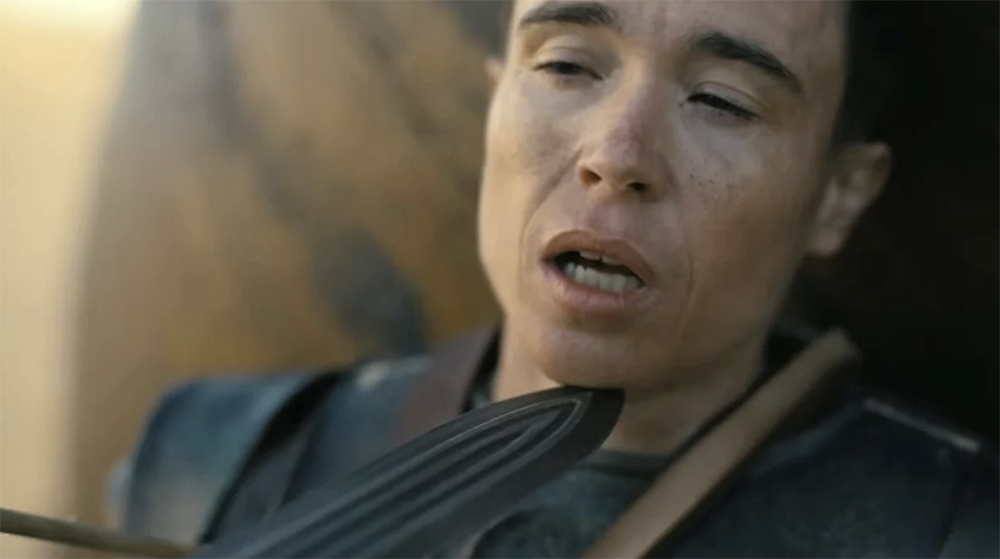
As for Elliott Page, the character is a small boy who is physically unimposing enough to be left behind with the horse to tell the Troy army guys that it is a present. He is not presented as a great warrior. Maybe 2 minutes of screentime in that. Is that too much for you? I have to assume you hate all Steven Seagal movies because he moved to Russia and you don’t watch Se7en anymore because of Kevin Spacey and all Marvel movies are out, etc, etc, etc. You better check everything you care about. Remember when Bud Light was being shot at for being “woke” and then they were a lead sponsor for the UFC, ripping up the White House lawn? Beware absolutism.
The movie is about regret. Powerful regret. Deadly regret. A decade of trying to overcome a regret in amazing and magical ways… but every morning, we all wake up with ourselves.
We have an administration in the White House in America right now that believes and repeats daily that regret is for the weak. So if that is your message… never regret anything… you’re always right… power us the only important measure of a human… you might find this movie very challenging. This is not the only reason you might find this movie challenging or even, for lack of a better term, bad. But I trust that you can manage to have a grown up discussion. You’ve read this far. (My apologies.)
Ironically, the sequence of this film that gets the biggest audience reaction - at least with the 3 audiences I have seen it with - is not only violent and thrilling, but involves direct human-on-human revenge. Is that woke? No. It’s kinda anti-woke. It kinda goes against the overall message of the movie. Killing against the rule of god (or the gods) is what the audience wants and supports in that sequence. Nolan had to see that coming. Odysseus feels the power of the gods and believes in them… and still denies them repeatedly in the film.
But that is why this is a good movie. Because we all feel what we feel and we all rationalize what we feel we need to rationalize. And whether we face “the gods” or our God or the person in the mirror, being a human being on this earth is complicated. In ancient times and today. There is no easy answer.
Christopher Nolan has always been one of the smartest filmmakers in the world. And his 26-year journey since Memento has taken him deep into his intellect and more and more into rich wells of emotion. We are now in the cycle of 2 movies about men of great power in deep regret and confusion about the power they have unleashed. Apparently, this is where Nolan sees the world these days. This is the topic he feels the need to discuss, through 2 very different guises. With different conclusions. Some may just take the ride. Others may not like what the movie has to say. Me? I walk away from The Odyssey - heading back in the next week - considering the choices of myself and others and living with those choices. How about you?
Until tomorrow…
I cannot read enough Nolan takes this week, and I especially appreciated this one, which will keep me walking with you beyond my great Substack Reaping to come. Yes, the first half of this brilliant movie sapped too much energy on Ithaca backstory, why aren’t more people willing to say this?
However, and perhaps you fixed this since your email went out, but it’s spelled “Memento,“ not “Momento.”
Thanks for letting me fixate on this.